Benton Area Transit service delivery
Status: Planning
Last updated: June 9, 2026
Location: Throughout Benton County
Project description
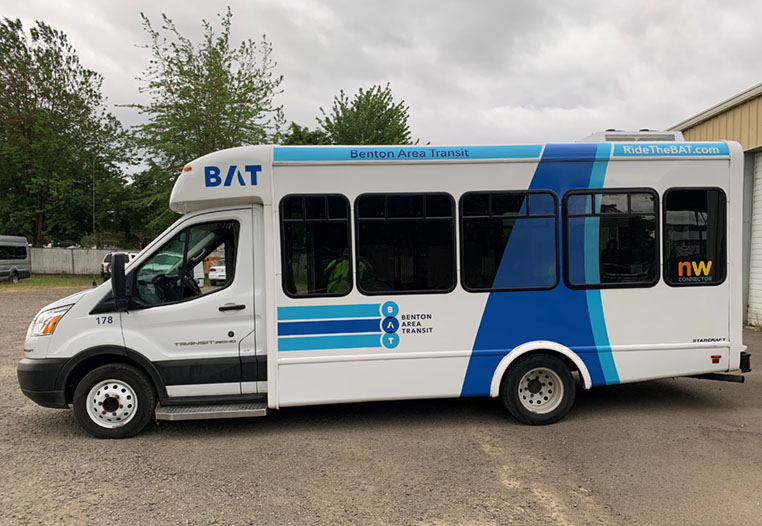
Benton County is exploring the best way to deliver Benton Area Transit (BAT) services with the goal of improving backend operations. There will be no change in the services provided to riders.
In the December 2, 2025 Board of Commissioners meeting, the Board, based on the results of an assessment conducted by transportation consultants Kittelson & Associates, directed County staff to investigate how BAT self-performance could be implemented and to create a draft implementation plan. This process will take many months.
In the April 14, 2026 Board of Commissioners meeting, the Board voted to expand the scope of the project (discussion of the expanded project scope begins at timecode 1:37:20). While developing the draft implementation plan for self-performance, the County will also draft a plan for a second scenario in which a contracted vendor still provides the service, but with an enhanced contract that includes standard payment terms and a higher degree of accountability and oversight. The change to the project scope will not affect the timeline.
Having two fully developed plans at the ready will put the County in the best position to ensure high quality, accountable and compliant services without disruption. If for any reason a contracted provider could no longer provide service, the County could quickly implement an already-developed self-perform model to continue providing critical transportation services.
When they are ready (probably near the end of 2026), the Board will review and discuss both draft implementation plans. They will take a vote and then instruct staff to begin finalizing the chosen plan so that it may be considered for budget adoption in May 2027.
Project goals
- Build fiscal sustainability
Better leverage funds to create cost-efficiency and lower cost variability to be on par with peer agencies. - Create efficient operations
Provide services that meet riders’ needs, scale operations according to long-range planning, and communicate transparently. - Provide context-appropriate service
Build administrative services to track needs and plan for maintenance, expansion, and regional coordination. - Maintain compliance
Ensure alignment with state and federal regulations and funding requirements and address any noncompliance findings.
BAT program analysis documents from Kittelson & Associates
Transportation consultants Kittelson & Associates assisted Benton County with a program assessment of the Benton Area Transit (BAT) service. The consultant team reviewed information provided by Benton County, Corvallis Transit System (CTS), National Transit Database (NTD), and Benton County’s current contract with Dial-A-Bus (DAB). The assessment provides a baseline for comparing alternative service delivery models and how they may impact costs and levels of service.
- Technical memorandum #1: Current service assessment. April 14, 2025
- Technical memorandum #2: Vision for service operations. June 17, 2025
- Technical memorandum #3: Future services delivery considerations. September 22, 2025
- Presentation to Board of Commissioners: Funding review. December 2, 2025
- Program Analysis Final Report. March 13, 2026
Supporting documents
- ODOT Compliance Review of Benton County 2020
- ODOT Compliance Review of Benton County 2023
- Memo: Benton Area Transit Self-Perform Analysis – Clarification. February 16, 2026
- Memo: Benton Area Transit Project – Scope Adjustment. April 10, 2026
Tentative timeline
| EXPECTED DATE | ACTION | STATUS |
|---|---|---|
| Winter 2026 | Establish team to create draft implementation plan | COMPLETED |
| Spring/Summer 2026 | Created two draft implementation plans for delivering BAT service: One for self-performance by the County and one for an enhanced contract with a service provider | IN PROGRESS |
| Summer/Fall 2026 | Collect feedback in public engagement sessions. The first session will be held in July and the second in September. Sign up to receive emailed invitations. Collect Commissioner feedback | |
| Fall 2026 | Develop STIF Funding Plan | |
| Commissioner decision – move to self-performance model or enhanced contract? | ||
| Spring 2027 | Funding for selected service delivery plan built into 2027-29 Proposed Budget | |
| May 2027 | 2027-29 Budget finalized, determining how BAT services are to be delivered in the future | |
| Fall 2027 | IF self-perform option is chosen by Board, pre-operational preparations begin | |
| July 1, 2028 | IF enhanced contract option is chosen by the Board of Commissioners, new contract takes effect. IF self-perform option is chosen by Board, service delivery change implemented. |
BAT Bulletin
Sign up to receive email updates once or twice a month. These will include periodic project updates and invitations to public engagement sessions in July and September 2026 where we’ll collect public input.
Archive
Frequently Asked Questions
Answers are being prepared for additional questions received from community members. This section will be expanded as more information becomes available.
Why didn’t Benton County ask for input from riders or the public before beginning this process?
Benton County began this process with no intention of changing the services provided by BAT. The same vehicles will provide rides to the same destinations during the same hours they are currently offered. Routes, days and times will not change.
What the County needs to change are some of the behind-the-scenes operations. These are things that riders and the public are unlikely to know much about. Some aspects of operations that are currently under consideration:
- Frequency of reporting, data to be reported, and format in which data should be reported
- Ensuring capacity to engage with regional partner agencies
- Minimizing annual cost variability
- Better understanding costs to support scaling and long range planning
- Streamlining ability to assess compliance with FTA requirements and address noncompliance findings should they occur
- Lowest risk option for insurance
- Safety training and drug/alcohol testing
- Grant tracking and applications
Because of the specialized nature of the work, the County sought input from a consultant specializing in transportation and from peers who provide transit services at the county level in Oregon.
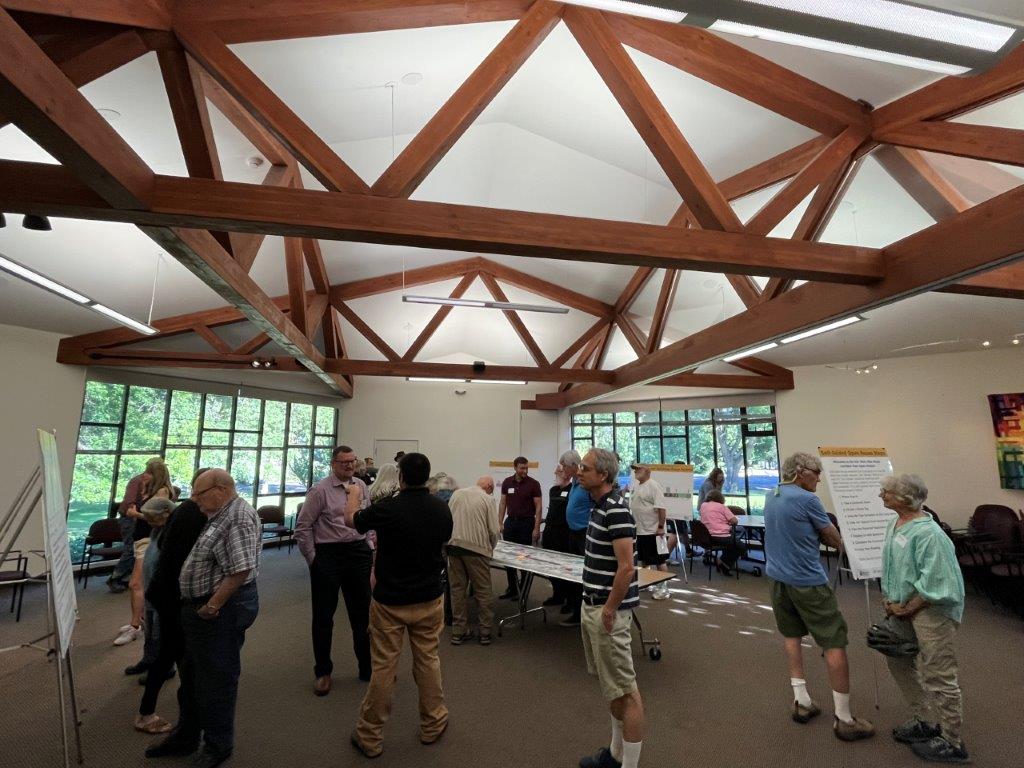
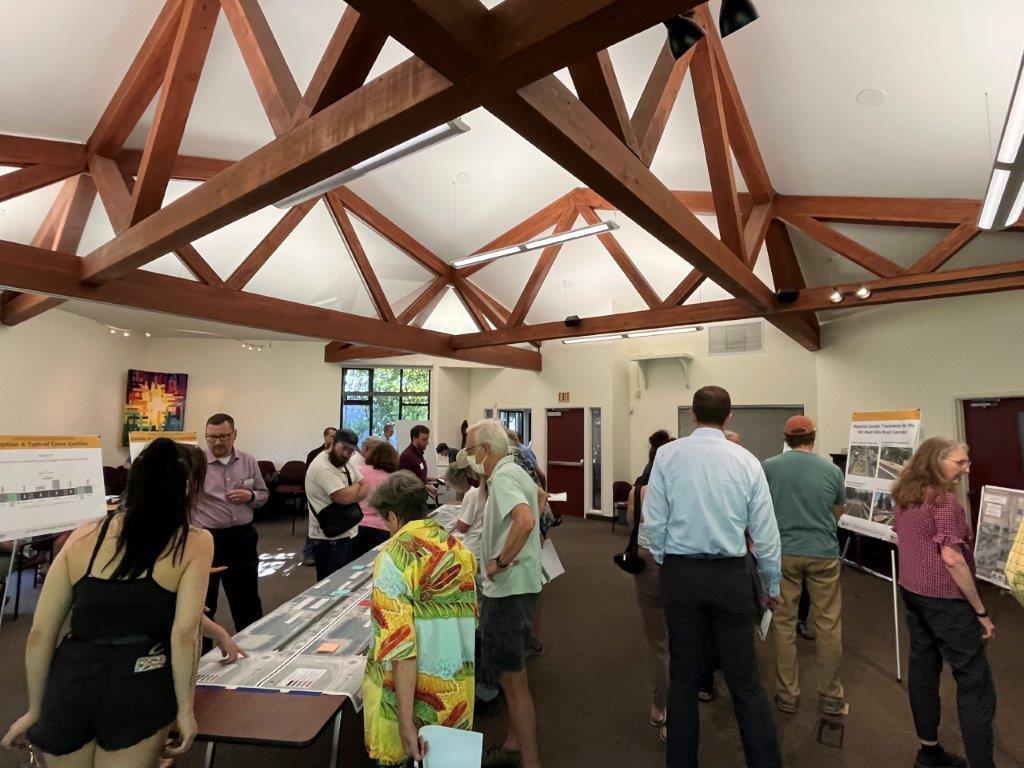
Riders and the public are invited to participate in public engagement sessions in July and September to learn about and discuss the two service models being prepared for consideration by the Board of Commissioners.
If the County makes changes to Benton Area Transit, when would it happen?
The current contract with Dial-A-Bus extends through June 30, 2028. Any change in service delivery will occur after that date.
What is the relationship between Benton Area Transit and Dial-A-Bus?
Benton Area Transit (BAT) is the County’s program. The County currently delivers our program services through a contract with Dial-A-Bus overseen by County staff. The resources to pay for these services are allocated to the County by the state and federal governments, to administer services in the manner determined by the County.
Dial-A-Bus has other services and other contracts unrelated to Benton Area Transit. These must be maintained separately from BAT.
Why is Benton County taking away BAT services?
BAT is not going away. No matter how the Board of Commissioners chooses to proceed, BAT services will not be eliminated or reduced. There will be no disruption in service. In fact, the County hopes to be able to provide more rides for community members, which is one of the reasons we are investigating a change.
Why is Benton County considering changing how BAT services are delivered?
- Federal 5311 funds are allocated to agencies based on vehicle revenue miles, so the County needs to ensure stable or increasing miles to prevent funding decreases.
- Agencies like Benton County are under increased pressure from new, stricter federal and state regulations and have new requirements for financial and operational transparency.
- Repeated federal noncompliance findings related to both administrative controls and how services are delivered are affecting the County’s ability to secure grants.
- There has historically been insufficient data to provide accurate cost estimates for appropriate resource sharing. The County requires reliable financial data.
- An assessment by transportation consultant Kittelson & Associates found that BAT’s demand-response service delivers 1.29 rides per hour, compared to a peer agency average of 2.66 — a significant efficiency gap the County plans to address.
What would change?
Depending which service delivery model is chosen for BAT, here are the changes riders can expect:
- Under a self-perform model, drivers will be County employees. If the County proceeds with the enhanced contract option, drivers will be employees or volunteers working for the contracted vendor selected through the RFP process. Either way, drivers will be easily recognizable by the Benton Area Transit logos on their shirts and/or nametags.
- Some rides could be shuttle-type service rather than taxi-type, with more than one passenger going to the same destination or area.
- Drivers will adhere to the terms of service, which includes not entering clients’ homes. The terms of service will not change.
Is Benton County shutting down Dial-A-Bus? Is this a hostile takeover?
Dial-A-Bus is an independent nonprofit organization, and the County never has and never will control their operations. They have their own executive director and board of advisors. They have other contracts to provide other non-County services. A change in the County’s contract with Dial-A-Bus for Benton Area Transit would not affect the organization’s other contracts and services.
DAB is also a tenant in the County’s Sunset Building on Research Way.
Who initiated the proposal to change the service model for BAT? When did the concept first come up?
County staff and leaders have been talking about Benton Area Transit service delivery for many years. When any big contract with a vendor comes up for renewal, the County is required to go through an RFP (request for proposals) process to ensure that we use vendors who bring the best balance of service, price and expertise. For BAT, this happens every five years, and the process involves the Board of Commissioners, Financial Services and Purchasing, and the Public Works department.
The County’s needs and the terms of the contract are updated with every RFP cycle. Until now, Dial-A-Bus has been the only applicant during RFP processes and has been awarded the contract. Now the County’s needs have changed to the point where they are not being met. Kittelson & Associates recommended drafting a plan to consider providing the services internally.
Is Benton County ending the contract with Dial-A-Bus to use another vendor to provide BAT services?
Benton County is not ending a contract with Dial-A-Bus. According to its terms, the current contract will end on June 30, 2028 after five years (the norm for the County’s contracts with DAB).
To renew the contract, the County must go through a Request for Proposals process that is governed by Oregon Public Contracting Code (ORS 279A and 279B). This includes advertising the opportunity openly and evaluating all proposals/offers objectively.
If the Board of Commissioners chooses to continue contracting with a vendor to provide BAT services, an RFP process will be conducted, as has been done many times in the past. Any interested vendor, including Dial-A-Bus, is encouraged to submit a proposal to provide services.
Is it true that the County will pay more to provide BAT services internally?
Both of the service models being considered for the future – a self-perform model delivered directly by the County or a continued contract-out model with enhanced accountability requirements – will cost more than the current model. Keeping the status quo could jeopardize the funding to provide these services, so one of the new service models will be implemented. The real difference in cost between a self-perform model and an enhanced contract-out model will only be known once we review the two proposed plans in the fall.
Is it accurate that the consulting firm (Kittelson & Associates) that analyzed the current operation was forbidden from gathering information directly from Dial-A-Bus?
Kittelson wasn’t prohibited from talking to Dial-A-Bus, but there was no identified reason for Kittelson to talk directly to the service provider.
Request for proposals (RFP) and contract language for the project is likely the source of the misunderstanding. The RFP for the project includes the following:
“Consultant will review publicly available information and/or information furnished by BC to better understand current transit services provided by DAB. This task will NOT include any direct outreach or interaction with the current contractor.”
The resulting contract with Kittelson & Associates includes this sentence:
“This task will not include any direct outreach or interaction with the current contractor.”
Language like this is not unusual in RFPs and contracts. It indicates to the contracted vendor (Kittelson, in this case) that the scope of work doesn’t need to include outreach to an entity (Dial-A-Bus, in this case) that can easily drive up the budget while returning only information already available from other sources.
Additionally, the County included these provisions to ensure an independent report be conducted utilizing programmatic information reported to Benton Area Transit (the County) from Dial-A-Bus.
Is it accurate that that the County is working from incomplete information regarding Dial-A-Bus operations?
The County responded to an earlier concern about incomplete information in the Kittelson analysis and has no reason to believe anything required for this stage of the project is missing.
In January 2026, the executive director and board of Dial-A-Bus contacted the county administrator and requested a meeting to follow up on the BAT presentation made to the Board of Commissioners on December 2, 2025. They met with the county administrator and assistant county administrator and discussed four specific items they felt were missing or misrepresented in that presentation. The county administrators wrote a memo to the Board of Commissioners that provided information and explanation to clarify the four points.
Since the January meeting, no additional concerns about incomplete information have been raised through any channels with the Commissioners, County administration, staff or the consultants.
What is the County’s definition of “sustainability” for BAT?
For Benton Area Transit, sustainability means always knowing the current status of operations and having a realistic plan for the future. It is a system that allows for a full understanding of known or predictable variables and confidence that resources and plans are in place to deal with the unexpected. This includes:
- The ability to quickly adapt to change and unexpected circumstances.
- Operating procedures with backups in place and clear contingency plans built in.
- Maintaining thorough and reliable financial data for transparent reporting and informed decision making.
- Operating with confidence that compliance measures are being met and service hours are maintained at the desired level so funding is not in jeopardy.
Would current Dial-A-Bus employees lose their jobs?
As an independent nonprofit organization, Dial-A-Bus manages their own staff. The County has no involvement in their hiring, staffing or any aspect of their workforce. Our contract outlines the County’s needs and expectations, and the board and executive director of Dial-A-Bus control how the contracted services are provided by that organization.
Why wasn’t the March 2 STIF Advisory Committee meeting listed on websites as a public meeting and hearing?
The March 2 STIF meeting was listed in advance on the Public Works Committee webpage as required. The meeting was not a public hearing and therefore was not noticed as a public hearing. The STIF Advisory Committee is not a quasi-judicial body and does not hold public hearings.
No extraordinary efforts were made to inform the public about the meeting because the County is not yet collecting public comment about the future operational model for BAT, and STIF meetings are not the correct venue for delivering that comment. STIFAC decides how STIF funds are allocated. The group has no authority to make operational decisions for County services and programs. BAT is one of the programs that receives STIF funding, and the matter was on the STIF meeting agenda on March 2 only as a short information update.
The County wants to hear feedback from the public at the appropriate time to act on it, and will schedule public engagement sessions for this purpose in July and September 2026. These public meetings will be advertised extensively.